Rare earth recovery from end-of-life magnets

Regenx is extending its hydrometallurgical platform beyond platinum group metals to neodymium and praseodymium, recovered from the permanent magnets inside end-of-life electronics and industrial equipment. The work is at laboratory scale, and the results are ours to prove.

Why this matters

The magnets are already here

Rare earth elements sit inside almost every technology that defines the modern economy: wind turbines, generators, hard drives, medical imaging, electric vehicles, aerospace and defense systems. There is no substitute for what they do.

Global production is heavily concentrated, and China holds the leading position in processing capacity. Meanwhile, neodymium-iron-boron magnets — roughly 22 to 31 percent neodymium by mass — are sitting in electronic waste and end-of-life equipment across North America: already mined, already refined, already here.

Regenx’s position is straightforward: the fastest domestic rare earth supply is the one that has already been paid for once.

The feedstock

End-of-life permanent magnets

The same neodymium-iron-boron magnets turn up wherever strong permanent magnets are used: inside end-of-life electronics, including computer hard drives, and inside larger industrial generators such as MRI machines and wind turbines. Wherever they come from, they are the same class of material — rare earth magnets that have already been mined and refined once.

Regenx’s research began with the most accessible of these: the small neodymium magnet in the actuator arm of an end-of-life hard drive. The team harvested those magnets and treated them as ore.

It is not a trivial feedstock. Magnets can be recovered from e-waste readily enough at laboratory scale; doing it at industrial volume is a genuinely different problem, and securing consistent supply is one of the central challenges facing every rare earth recycler. Regenx treats that as an engineering problem to be solved, not one to be glossed over.

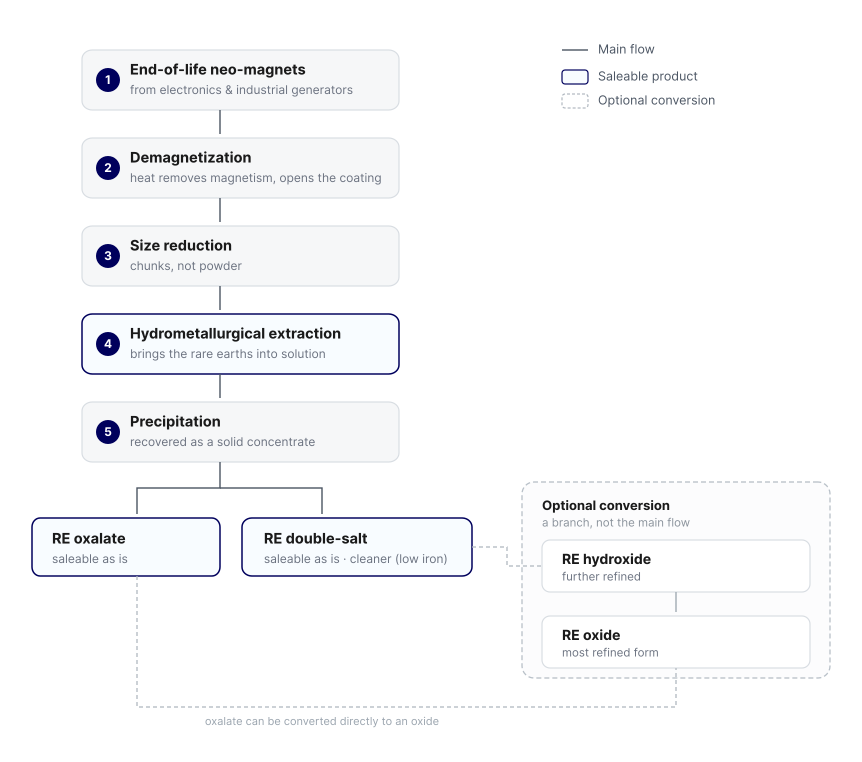
Five stages, one existing platform

Five stages, one existing platform

What the lab found

Results to date

Recovery is not the same as grade. The two are easy to confuse, so the page states the difference plainly. Recovery (~99.5%) is the share of the target metal the process captures. Grade is the share of the final solid concentrate made up of a given element. A moderate grade does not mean low recovery: the process captures almost all of the target metal, then concentrates it into the product forms below.

~99.5%

Recovery into solution

Across the hydrometallurgical routes tested, Regenx consistently brought about 99.5% of the neodymium and praseodymium out of the magnet feedstock and into solution under optimized conditions — the strongest, most consistently reproduced figure in the research.

Four product forms — each a further step along the purification path:

What the lab found

RE oxalate

The simplest to produce, but it carries iron contamination — and there is currently no known chemistry that removes iron oxalate selectively.

Saleable as is · cleaner

RE double-salt

Materially cleaner than the oxalate, bringing iron down to roughly half a percent. Where product purity matters, this is the stronger of the two direct products.

Optional conversion

RE hydroxide

An optional conversion of the double-salt, one step further refined. A conversion product, not a required stage.

Optional conversion

RE oxide

The most refined form, produced by converting the hydroxide — or the oxalate directly. Also an optional conversion product.

Composition of the recovered concentrate (ICP-OES, laboratory results)

Product form

Nd (%)

Pr (%)

Fe (%)

Oxalate route

70.3

9.6

6.6

Double-salt, route A

76.1

7.8

0.4

Double-salt, route B

72.7

11.4

0.5

Double-salt, route C

59.6

8.4

0.4

Each figure is the share of that product made up by the element — a composition, not a recovery rate. Grades are ICP-OES analyses of final precipitation products produced in Regenx’s laboratory from accumulated process solution. They describe specific test products at laboratory scale, not a product specification.

Known limitation, iron. The oxalate route carries iron that cannot currently be removed selectively; the double-salt routes produce materially cleaner product. Regenx states this plainly because any competent reviewer of the chemistry would ask.

How we know

The analytical work

Regenx operates its own mineral processing laboratory in the Greater Vancouver area, equipped with OES-ICP and XRF analytical instruments capable of performing comprehensive analyses.All product grades presented on this page were generated in that laboratory by ICP-OES.

The research team & documentation · proposed, pending sign-offs

Built like a research program

The rare earth research program was carried out by Regenx’s technical team:

Fabricio Maia

Director of R&D

Evan Ben-Oliel

Nolan Parker

past contributor

Samanta Klein

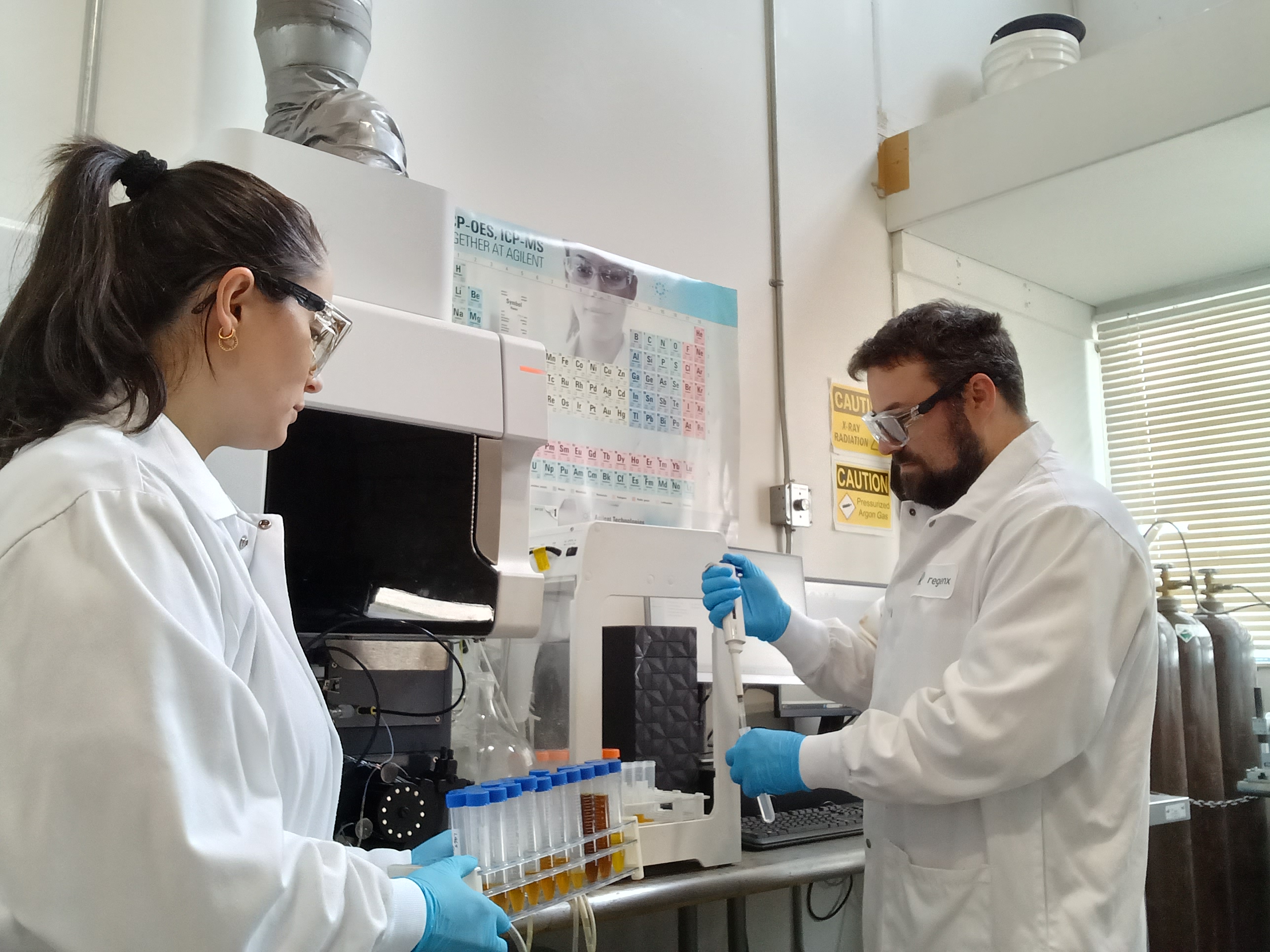
Members of the Regenx technical team at work in the company's mineral processing laboratory.
Where this sits

An emerging platform

This is laboratory-stage work. The research has demonstrated that Regenx’s existing hydrometallurgical infrastructure can be adapted to recover rare earths from NdFeB magnets, and it has identified the operating conditions that work. It has not yet been run at commercial scale, and the company is not representing that it has.

The next phase of work is defined: optimizing feed size and reagent consumption, controlling impurities, extending recovery to dysprosium and terbium, and establishing feedstock supply at volume.

Regenx is publishing this because the results stand on their own at the stage they are at.